
Case study
The Turing Trust was set up by Alan Turing’s family to honour his legacy. He’s generally regarded as the father of modern computing – but he was also committed to helping others, believing in the power of education in helping people fulfil their potential. The trust’s aim is to ensure that one day every child will be able to enjoy the transformative power of technology that Alan envisaged.
To achieve this, the trust refurbishes donated IT equipment and distributes it to classrooms around the world – enabling access to computers for more than 250,000 students in the past 15 years.
The trust also provides training to teachers and students, empowering them to develop their own skills. And, of course, another benefit of their work is the resulting reduction in electronic waste.
As a B Corp committed to doing work that has a positive impact on people, planet and prosperity, Opencast was keen work with them. The trust needed to maximise its ability to get refurbished technology to the people who need it as quickly and efficiently as possible, by improving their warehouse operations.
Opencast was introduced to the project in 2024 through our membership of the Tech for Good Alliance, which accelerates the development of UK tech for good by connecting tech businesses with non-profits. Working on a pro bono basis, in early 2025 we contributed digital expertise to help develop a bespoke warehouse management system that’s enabled the Turing Trust to process and ship refurbished tech quickly and efficiently.
Challenge
Warehouse management processes in need of an update
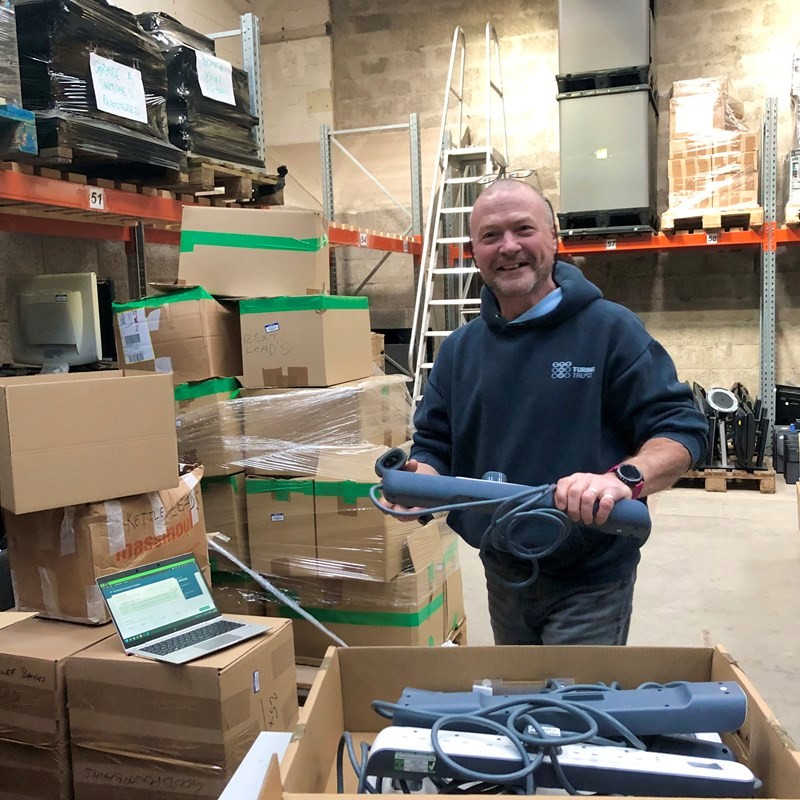
The Turing Trust’s warehouse operations and stock management relied on manual processes – with volunteers having to manually comb through the warehouse to find a specific donation or pallet. It was a loud and busy environment and volunteers often struggled to locate items, so finding the right equipment could often be a time-consuming and frustrating process.
Opencast put together a team to work with the Turing Trust to help it develop a system to track, manage and ship its stock in a way that would be intuitive and efficient to use – and so minimise the frustration and delay they were experiencing with their workflows. The trust was using a bespoke application and hand-held scanners to update the status of each donated item. But the app was tricky to use, lacked functionality that would have been useful, and had some features that were redundant.
Response
Understanding user needs to design a better workflow
A small Opencast team added expertise in interaction design and software development, supported by product management and quality assurance. Working alongside the trust’s internal team, we set out to design and build a solution that would allow employees and volunteers to locate and retrieve donations in the warehouse without relying on manual processes.
But first, the Opencast team needed to evaluate the existing application and investigate if we could expand and build upon it, as well as ensure we understood the needs both of the volunteers using the tech in the warehouse and their backend needs as an organisation.
So, we spent the first couple of weeks doing some research to understand the existing application, what did and didn’t work and understand the user needs we’d be aiming to meet with the final designs.
The team mapped out the existing as-is service to understand the decisions that were being made throughout, from receiving a piece of tech to it leaving the warehouse. We identified key areas of improvement, focusing on where location tracking could be implemented, how it could work and what technologies we could use within the tight timescales of the project.
The Opencast team worked closely with stakeholders at the trust to understand and map its existing tech stack, API structure and how each integrated into Salesforce, ending up with agreed goals for the project.
It was during these initial two weeks of discovery that a larger, underlying issue was uncovered. The existing application that the trust used meant that software had to be installed on laptops for its users. This created barriers for the users, slowing down or stopping their ability to use the tech.
As a result of this, our team proposed a web app that could be accessed via the trust’s private network. The team took the opportunity to improve the user experience, content and flow of the application during this process. We realised this was ambitious considering the time constraints - but it was still possible. Having a clear plan of action and an enthusiastic, experienced team was key.
The team set about creating a ‘to-be’ user journey, incorporating both existing and new functionality, in line with the needs uncovered in our research. Using this understanding, we designed a new, more intuitive user interface, running some initial usability tests and iterating the designs based on their feedback.
By the end of week six the team was ready to hand over an initial version of the application for trust volunteers to test in the warehouse. We had to be flexible in the way we approached testing, enabling the trust team to test in its own warehouse environment and feedback its findings.
In the remaining time working with the trust, the Opencast team refined the application in response to insights from that first round of testing and added a content designer to the team to review and tweak the language used in the app to make sure it was clear and user-friendly. The team also made some final amends to the user interface to ensure it was as easy and intuitive to use as possible.
Impact
Accurate, intuitive application that maximises efficiency
In nine weeks the Opencast team delivered software with multiple benefits that make using it easier and more efficient. These include:
A more intuitive user interface that is also on-brand for the Turing Trust. It guides the user through the process at hand, leading to quicker completion of scanning and packaging
Accurate real-time tracking of assets in Salesforce, by adding functionality that allows volunteers to scan them as they box up equipment in the warehouse
A new 'move assets to a new location' mode to enable the trust to quickly move assets in bulk from one location to another
A web-based application that can be accessed by volunteers on a multitude of devices, rather than specific devices which had to have software installed.
Importantly, the result is an application built alongside and with the skills of trust’s team in mind. Its team is made up predominantly of backend engineers, so we built pages driven by the APIs they create. This means they can easily add new functionality in future with little to no front-end expertise.
A key benefit of the collaboration is helping to streamline the trust’s operations in more general ways. For example, the warehouse has racks, each with space for three pallets full of assets. However, one ‘pallet’ (identified by a unique reference number) could actually be three physical pallets spread over multiple warehouse racks. This has now been streamlined so that one pallet in the warehouse equals one pallet reference number in Salesforce. The project was fast paced and satisfying. Opencast established a strong relationship with the Turing Trust, keeping in regular contact via show-and-tells and ad-hoc Teams chats, and making sure that any questions or blockers were addressed quickly.
The trust is already seeing benefits from the new software. There is less training needed, meaning volunteers can quickly get to work processing orders. And the fact that it’s a web-based solution means it can be accessed on any device connected to the trust’s network. There is no need to install specific software, which was a real barrier to some. Location-based tracking means volunteers can locate any asset in the trust’s warehouse accurately and quickly.
It will also be easy for the trust to scale with little to no front-end work required. This is a real benefit for the trust, with its team of mainly back-end developers.
Importantly, the trust’s volunteers – who are so central to the success of the operation - are happy with the new software. They enjoyed being involved in testing the application as it was being developed it and gave very positive feedback - including sharing footage of the new app in use.
12,600
extra students learning IT
70+
touch points since go-live
10,000
internal users

James Turing
Founder & Chief Executive, The Turing Trust
Access case study
Get your copy of Opencast’s case study, just share your name and email.
GG Care: Voice Technology for Dementia Support
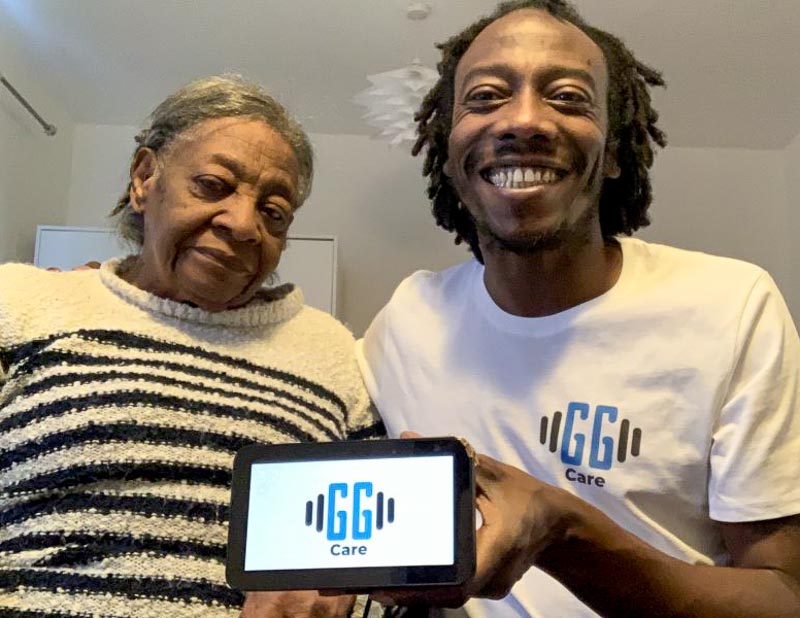
GG Care, a company using technology to support people living with dementia with everyday activities using interactive voice reminders.
Case study


Joining forces with The Fore to show the impact of non-profits
Venture philanthropy fund The Fore teamed up with Pro Bono Economics on a project to help them measure the collective and individual impact of the non-profits they fund. Working on a pro bono basis, Opencast helped to develop a bespoke data collection survey. Our collaboration successfully delivered a fully functional, cost-effective and GDPR-compliant survey platform in just six weeks.